
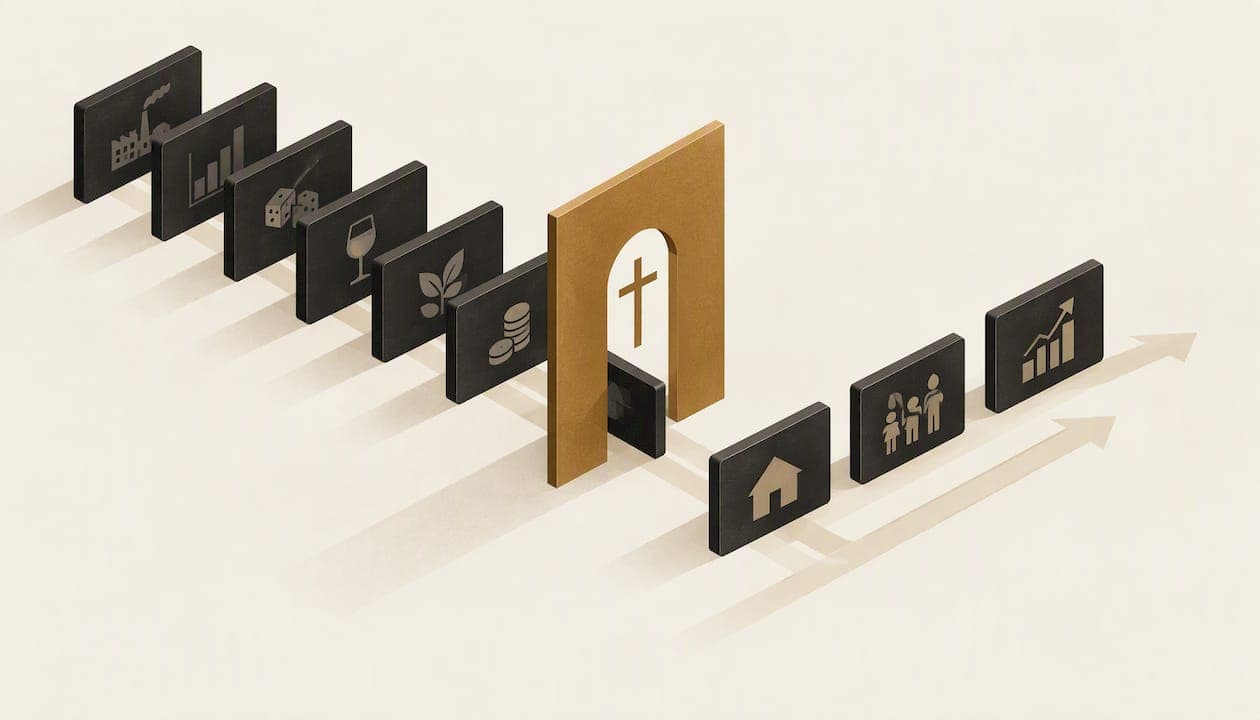
Biblically responsible investing, often shortened to BRI, is the practice of choosing investments in light of your faith: avoiding companies whose products or practices you believe conflict with Scripture, using your voice as an owner, and favoring businesses that serve people well. It is not a single fund or a secret formula. It is a set of convictions you turn into a plan, and for most families it begins at the kitchen table, not in a brokerage account.
This guide explains what BRI is, which biblical principles stand behind it, how screening actually works, where Christians honestly disagree, and how to have the conversation as a couple or family without guilt or shame.
TL;DR
- BRI is a thematic investment style that lets Christians apply their faith to investing, and it goes by other names such as stewardship investing or faith-based investing.
- Most BRI uses three tools: avoid certain companies, engage companies as an owner, and embrace investments that do good.
- Christians disagree about what counts as objectionable (alcohol is a classic example), so write down your own list before choosing a fund.
- Diversification, fees and risk still matter. Studies show no clear performance advantage or penalty for BRI.
- Talk first, invest second: agree on convictions as a family, then bring them to a qualified financial professional.
Table of Contents
- What biblically responsible investing means
- The biblical principles behind it
- Three ways Christians put it into practice
- How screening works in practice
- Where Christians honestly disagree
- Does BRI cost you returns?
- How to invest biblically, step by step
- Talking about it as a couple or family
- Our perspective on faith and investing
- A simple next step for your family
- FAQ
- Sources
What biblically responsible investing means
Houghton-area scholars at Houston Christian University describe BRI as a thematic investment style that lets Christians explicitly bring their faith into investment decisions, treating investing as a modern application of Scripture on stewardship. You will also see it called stewardship investing, morally responsible investing or faith-based investing.
The same source places BRI in a longer family tree. It is a specifically Christian extension of socially responsible investing (SRI) and a further step beyond ESG investing. That helps with a common question: how is biblical investing different from ESG? ESG looks at environmental, social and governance factors through a broad, secular lens. BRI starts from a specific moral source, the Bible, and so it asks different questions. An ESG fund may care a great deal about carbon and little about pornography or predatory lending. A BRI approach may weigh those the other way around, or weigh them all.
The label is newer than the idea. Believers have long asked whether it is right to profit from a business whose work they could not do themselves. What has changed is that today you can own thousands of companies through a single fund, so the question of what you own is far less obvious than it was for a farmer buying a field.

The biblical principles behind it
No verse says "buy this index fund." What Scripture offers is a set of principles about money, work and people. The Christian Investing Council's 2026 statement on Christian investing and its biblical and theological background frames the starting point this way: since the fall, Christians are called to integrity, moral discernment and action, and to resist conformity to worldly powers.
From that foundation, believers commonly draw on a handful of themes:
- Holiness. Your resources are part of a life set apart for God, so what your money supports matters.
- Stewardship. Everything we manage belongs to God. We are managers, not owners (Psalm 24:1).
- The dignity of human life. Investments that profit from harming people deserve scrutiny.
- Justice and mercy. Treat workers, customers and the poor fairly, and avoid exploitation.
- Salt and light. Jesus called his followers to be salt and light in the world (Matthew 5:13-16), which many read as a call to let their economic choices bear witness.
- Contentment over materialism. Wealth is a tool, not a master (Matthew 6:24).
The same Christian Investing Council statement adds something many families miss: Christian investing is not only about avoidance. It describes investing as putting capital at risk for mutually beneficial economic cooperation that creates financial and non-financial value, while rejecting the hoarding of wealth. In other words, the Bible does not tell you to stay out of the market. It tells you to participate wisely and generously.
What does the Bible say about investing in stocks?
Stocks do not appear in Scripture, but investing as a concept does. Proverbs 21:5 says the plans of the diligent lead to profit. Ecclesiastes 11:2 advises dividing your portions among seven or eight ventures, an ancient case for diversification. The parable of the talents (Matthew 25:14-30) praises servants who put their master's money to work and rebukes the one who buried it out of fear. Proverbs 13:11 warns that wealth gained hastily dwindles, which is a fair caution against speculation. For a deeper look at the saving side, see our walk through Bible verses about saving.
Three ways Christians put it into practice
The Christian Investing Council describes three primary approaches: avoiding investments that hinder faith integrity, engaging to use investor influence, and embracing investments aligned with God's intended shalom for the world. Here is what each looks like for an ordinary family.
Avoid
Avoidance, usually called screening, means you do not own certain companies. A Houston Christian University publication on BRI notes that investors can identify objectionable activities based on faith and either screen out the companies involved or engage them through proxy voting and shareowner proposals.
Engage
If you own shares, you are an owner, and owners vote. Funds vote on your behalf, so it is fair to ask any fund you consider how it votes and whether it files or supports shareholder proposals. Engagement is slower than avoidance but it can change behavior from inside rather than simply walking away.
Embrace
Embracing means looking for businesses that do visible good: honest products, fair employment, serving real needs, and in some cases helping low-income communities access fair credit. This is the side of BRI that is easiest to forget and, for many families, the most motivating.
How screening works in practice
Screening can sound mysterious, but the mechanics are simple. A research article in the Christian Business Academy Review looked at one BRI screening firm that evaluates companies on 70 parameters across 12 categories: abortion, alcohol, anti-family activity, bioethics, contraceptives, gaming, human rights, low-income financial services, non-married lifestyle, pornography, positive activity and tobacco.
Two details from that research are worth carrying into your own thinking.
First, the categories include a "positive activity" bucket, which confirms that screening can reward as well as exclude.
Second, the authors note that effective stock selection can involve reviewing specific parameters and focusing on the violations that concern the team or client most, rather than automatically excluding every stock above a total-score cutoff. That is good news for families. You do not need to adopt someone else's entire list. You can decide which issues are non-negotiable for you and which are matters of degree.
Best practices from the research
The Houston Christian University publication summarizes best practices for BRI in a way any family can adapt:
- Know what you own.
- Define the specific categories you consider objectionable.
- Use screening tools to check holdings against those categories.
- Set threshold criteria for when you avoid a company and when you engage it.
- Build a diversified portfolio of undervalued or fairly valued investments.
Notice the order. Conviction comes first, tools second. If you pick a fund first and then discover what it holds, you are working backward.
Where Christians honestly disagree
BRI is not a monolith, and pretending otherwise would be unfair to your family and to your church community. The same Houston Christian University publication points to alcohol as a clear point of divergence: some traditions cite John 2:1-11 and 1 Timothy 5:23 in support of moderate use, while others object because of concerns about addiction and destructive behavior.
The publication also observes that many responsible Christians value diversification and hold index mutual funds or ETFs, while still disagreeing about what counts as objectionable. That means a fund labeled "biblical" reflects one set of judgments, not the only faithful set.
Gambling is another category where thoughtful believers land in different places. If it is on your list, our article on whether gambling is a sin offers four tests for Christian stewardship that translate well to a screening decision.
The practical lesson: read what a fund screens, not just what it calls itself. Ask for its exclusion list and its voting record, and compare both with the convictions you wrote down.
Does BRI cost you returns?
This is the question most investors worry about quietly. The Houston Christian University review reports that studies show no clear performance benefit or penalty for BRI and SRI, with results that vary by time period, benchmark, fund type and fees.
That should be freeing and sobering at once. Freeing, because there is no solid evidence that faithful investing must mean worse results. Sobering, because there is no evidence it guarantees better ones either. What does move your outcome, as with any portfolio, are the ordinary things: how diversified you are, what you pay in fees, how long you stay invested and how you behave when markets fall.
A few questions to ask of any faith-aligned fund or advisor:
- What does it cost each year, all fees included?
- How many companies does it hold, and in how many industries?
- Does it publish its screens and its proxy votes?
- Who decides what is objectionable, and can that change?
Before you move retirement accounts or sell holdings to align with your convictions, speak with a fee-only fiduciary financial advisor and, where taxes are involved, a tax professional. Selling in a taxable account can create a tax bill, and your situation, not a general guide, decides what is wise.
How to invest biblically, step by step
Here is a simple sequence for a couple or family just starting out.
- Stabilize the foundation first. Biblical wisdom prizes getting out from under burdens before building wealth (Proverbs 22:7). If consumer debt is draining you, tackle that and build a small emergency cushion before worrying about fund labels. Our guide to starting biblical budgeting tonight is a gentle place to begin.
- Settle giving. Decide how you will approach generosity so investing does not crowd it out. Our tithing checklist for gross or net can help you reach a decision together.
- Write your convictions. List three to five issues you would avoid, two or three you would actively support, and one or two you are still praying about.
- Look at what you already own. Employer retirement plans and old accounts often hold broad funds. Find the top holdings and compare them with your list.
- Choose a structure. Options broadly fall into diversified index funds or ETFs you screen yourself, faith-based funds that publish their screens, or a professional who manages screened portfolios for you. Each has trade-offs in cost, control and convenience.
- Write a one-page plan. Include your convictions, your target mix, your review date and who is responsible for what.
- Review yearly. Convictions deepen, funds change and life shifts. A yearly check-in keeps the plan alive without turning into anxiety.
Talking about it as a couple or family
Research can tell you what BRI is. It cannot tell you what your family believes, and that is where most plans stall. One spouse may care deeply about avoiding certain industries while the other focuses on retirement security. Neither is wrong. Both are stewardship.
A few ways to keep the conversation calm:
- Start with Scripture, not spreadsheets. Read a short passage together, such as the parable of the talents, and ask what it says about faithful use of what you have been given. Our Bible study on money for families provides ready lessons for this.
- Ask before you assert. "What worries you most about our future?" opens more doors than "We should be doing this."
- Separate conviction from preference. Some items are matters of conscience. Others are simply tastes. Name which is which.
- Agree on a decision rule. For example: we change nothing above a certain amount unless we both agree and have spoken with an advisor.
- Include the children at their level. Teenagers can follow a simple story of what a company does and why you would or would not own it. Younger children can learn that money is something we manage for God.
- Drop the shame. If past choices were uninformed, you are in good company. Starting now is enough.
For more practical steps on turning principles into habits, see 10 actions for putting biblical money principles to work.
Our perspective on faith and investing
At Bible About Money, we meet families where the pressure actually is: debt, spending, and conversations that go sideways. We have found that very few people are stopped by a lack of information about funds. They are stopped by a lack of agreement, and by quiet fear of getting it wrong.
That is why we believe the order matters. Start with the heart and the home. Settle what you believe God has asked of you as managers of his resources. Get the simple things in place, a plan to be free of burdens, a habit of giving, and a calm way to talk. Then, and only then, let investing express what you already hold.

We also believe BRI works best when it is held with humility. Faithful Christians land in different places on alcohol, gambling and many other questions, and no label can settle your conscience for you. So we encourage you to read Scripture for yourselves, weigh wise counsel, and give each other grace.
Most of all, we want you to know that you do not have to get this perfect. God is not asking for a flawless portfolio. He is asking for faithful hearts and wise steps, one conversation at a time.
— James
A simple next step for your family
If talking about money feels tense in your home, start smaller than investing. The Bible Money Book is a digital guide for $1 that offers simple, actionable steps rooted in biblical principles, with an implementation guide to help families have calmer conversations about debt, spending and decisions. It is designed to be a clear next step without judgment or shame. You can also explore our recommended Christian books and Bibles if you want further reading on stewardship and business, or our daily Bible money wisdom for a short, steady reminder each day.
FAQ
What is biblically responsible investing?
It is a thematic investment style that lets Christians apply their faith to investing, sometimes called stewardship or faith-based investing. In practice it combines avoiding certain companies, engaging companies as an owner, and favoring investments that do good. It is a Christian extension of socially responsible investing.
How is biblical investing different from ESG?
ESG weighs environmental, social and governance factors from a broad, secular viewpoint. BRI begins with Scripture and its moral priorities, so its screens may differ, for example by addressing issues such as pornography or predatory lending that some ESG approaches treat lightly. Researchers describe BRI as a further evolution of ESG rather than a copy of it.
Does biblically responsible investing lower returns?
Studies reviewed by Houston Christian University researchers found no clear performance benefit or penalty for BRI and SRI, and results vary by period, benchmark, fund type and fees. Diversification and low costs matter more to your outcome than the label does. Talk to a fiduciary advisor about your specific situation.
Can a Christian own index funds?
Yes. Many responsible Christians hold diversified index mutual funds or ETFs, even while they disagree about which activities are objectionable. If a broad fund holds companies you would avoid, you can look for a screened alternative or discuss options with an advisor.
Where should a family start?
Start with the conversation: write down shared convictions, then check what you already own. If debt or budgeting stress is high, handle that first, since stable footing makes every investing decision calmer.
Sources
- Biblically Responsible Investing, Houston Christian University Center for Christianity in Business (2023)
- Biblically Responsible Investing in the New Kingdom Economy, Christian Business Review (2021)
- Biblical Screens and the Stock Selection Process, Christian Business Academy Review (2019)
- CIC Statement on Christian Investing with Biblical and Theological Background (2026)