
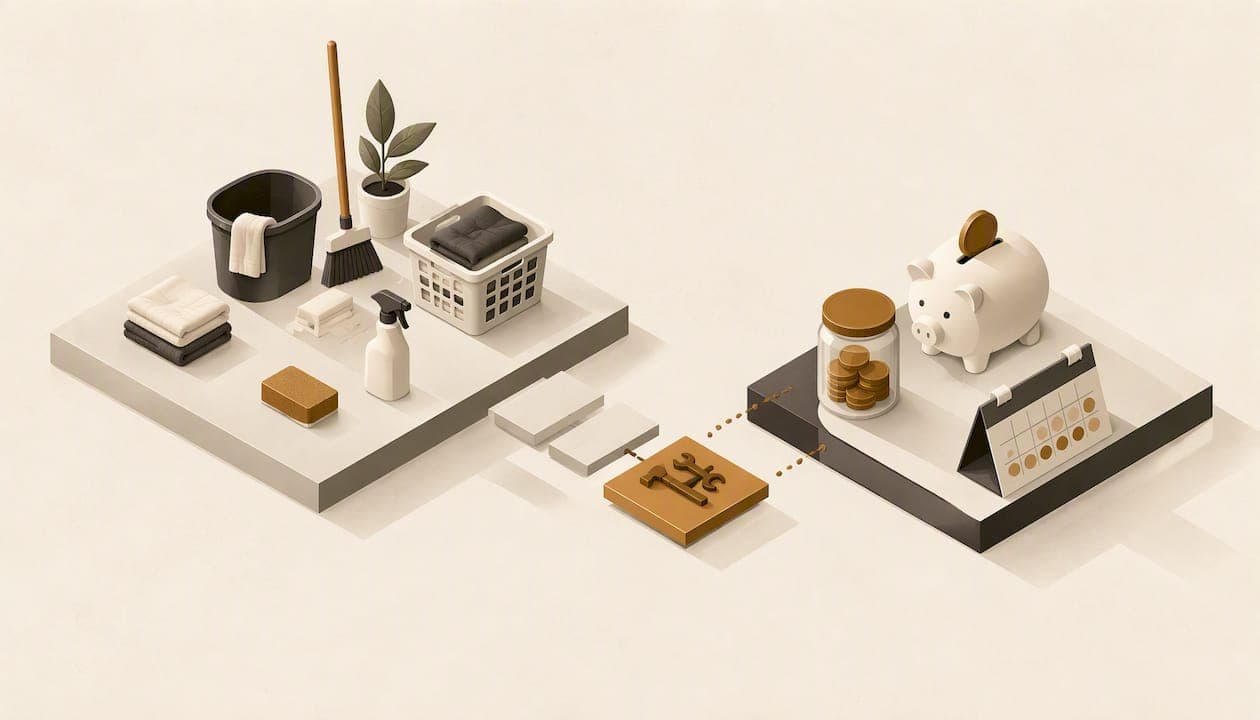
The best way to handle chores and allowance is to treat them as two different lessons. Chores teach a child that every person in the family carries part of the household. Allowance teaches a child how to handle money: giving, saving and spending. Many Christian families find this separation calmer, and it fits Scripture well. You can still let a child earn extra money through bigger jobs, as long as the daily work of family life is never up for sale.
Below you will find the reasoning, a simple plan you can start this week, amounts by age, and the questions parents ask most often.
TL;DR
- Keep two buckets: family chores (unpaid, because we all belong to the household) and allowance (a small, regular amount used as money practice).
- Offer paid "extra jobs" for work beyond the normal routine, so kids also learn that effort earns income.
- Split every allowance into give, save and spend so generosity is a habit before it is a lecture.
- Start small, stay consistent, and talk about money without shame. A calm conversation teaches more than a perfect chart.
- Use a one-page plan, not a complicated system. If it takes more than five minutes a week to run, simplify it.
Table of Contents
- Why parents argue about chores and allowance
- What the Bible says about work, family and pay
- The two-bucket plan: chores and allowance, kept apart
- How much allowance, and at what age?
- Teaching generosity with the Give jar
- A simple weekly rhythm
- Do you need an app?
- Common mistakes to avoid
- Our perspective: calm first, system second
- A simple next step for your family
- FAQ
- Sources
Why parents argue about chores and allowance
Most parents agree that children should help at home. The disagreement is about why. In a piece on paying for chores from the U.S. Army, some parents are described as thinking about fairness (everyone benefits from a well-run home, so everyone contributes), while others think about responsibility and teaching the value of work. Both instincts are good, and both can be honored.
The trouble starts when the two ideas get tangled. If every task has a price, a child can reasonably say, "How much will you pay me to set the table?" If allowance is withheld whenever a chore is forgotten, money becomes a lever for control, and money talks start to feel like a courtroom.
The University of Arizona's work-life program puts it plainly in a March 2026 article: chores and allowance are two useful tools, but they work better when kept separate. The Kids' Money guide reaches a similar conclusion and explains why it does not tie them together.
That is not the only view, and it is worth being honest about that. One chore-chart resource says there is no moral high ground here: some families pay for jobs, while others pay a small allowance and still expect the dishes to be done. What matters is that you choose on purpose, explain it, and stay steady.
What the Bible says about work, family and pay
Scripture does not give a verse that says "ten dollars a week at age ten." It gives us principles that shape the decision.
Work is good, and it has fruit. Proverbs 14:23 says that all hard work brings a profit. A child who learns to finish a task, even a small one, is learning something Scripture treats as honorable. A Bible reading plan for kids and chores uses this same verse, then makes a thoughtful point: work at home is not a zero-sum game, because each person's work benefits everyone else in the family.
Family members serve one another. In a home, nobody sends a bill for dinner. A parent cooks, a child sets the table, and love is the reason. When chores are unpaid, they quietly teach that we serve people because we belong to them.

Pay is real, too. Paul wrote that anyone unwilling to work should not eat (2 Thessalonians 3:10), and the Bible speaks of workers being worthy of their wages. So it is also right for a child to learn that extra work, done well, can earn extra income. That is the role of paid extra jobs.
Money is a tool for giving. Luke 6:38 and 2 Corinthians 9:7 both point to generous, cheerful giving. An allowance is the perfect training ground, because the amounts are small and the lessons are large.
Planning beats hurry. Proverbs 21:5 speaks of the plans of the diligent leading to profit, and Proverbs 13:11 says wealth gathered little by little grows. Saving a few dollars toward a goal is that proverb in a child's hands.
If you want a quick tour of key verses for your own family conversations, our post on 12 Bible verses about money for Christian families gives one tiny action for each.
The two-bucket plan: chores and allowance, kept apart
Here is the structure we recommend to families who want something simple.
Bucket one: family chores (unpaid)
These are the daily and weekly tasks that come with living in the home: making the bed, clearing dishes, putting away laundry, feeding the pet, tidying shared spaces. Nobody is paid for them. You can say it like this:
"In our family, we all help because we all live here. Allowance is a different thing. It is money for you to practice with."
What if a chore is skipped? Use consequences that fit the problem. The task still has to be done, perhaps before a screen or an outing, but you do not need to raid the allowance. Researchers have long studied how external rewards can change how kids feel about an activity. A classic Stanford study on superfluous constraints and intrinsic interest is one of the often-cited papers on that theme, which is part of why many parents are cautious about attaching a price to everything.
Bucket two: allowance (regular, predictable)
Allowance is a weekly amount given on the same day, no matter what kind of week it was. Predictability is the point. A child cannot practice budgeting with an income that changes by mood.
Then divide it. A simple starting split:
| Jar | Share | What it teaches |
|---|---|---|
| Give | 10% or more | Generosity and trust in God's provision |
| Save | 30% to 50% | Patience and planning toward a goal |
| Spend | The rest | Choices, trade-offs and the feeling of a purchase |
These percentages are our suggestion, not a rule from Scripture. Adjust them to your family. The habit matters more than the exact figure.
Bucket three, optional: paid extra jobs
If you want your child to see the link between effort and income, offer jobs outside the normal routine: washing the car, helping clear a garage, raking a neighbor's yard with you, or a bigger spring cleaning project. Agree on the price before the work begins, and pay when the work meets the standard. This gives you a place for the "worthy of wages" lesson without turning the whole house into a payroll department.

How much allowance, and at what age?
There is no official number. Families differ by income, region and the expenses the child covers. Here is what current data suggests about what others are doing.
An August 2026 survey reported by the ABA Banking Journal found that 68% of parents and 58% of grandparents give their children an allowance. Respondents generally thought the right age to start is between 5 and 12, with 8 the most common answer. Parents in the survey said a fair weekly amount is $21 on average, while grandparents said $15.
Those figures are averages of opinion, not a standard you must meet. A popular rule of thumb, repeated in many parenting guides, is about $1 a week for each year of age. You might use it as a starting point and then adjust.
A more useful question than "How much?" is "What will this child pay for?" Consider the following approach:
- Ages 4 to 6: Very small amounts, often coins you can count together. Use clear jars so they can see the Give, Save and Spend piles grow.
- Ages 7 to 9: A weekly amount with a savings goal, such as a toy or a gift for a sibling. Let them wait, and let them feel the wait.
- Ages 10 to 12: Add responsibility. They might pay for a small category such as snacks out, party gifts or app purchases. Mistakes are cheap now and costly later, so let them happen now.
- Teens: Move toward a monthly amount that covers clothing, entertainment or fuel contributions, along with a basic budget and a conversation about earning outside the home.
If the amount is large enough that your child never feels a trade-off, it is too large. If it is so small they cannot buy anything meaningful, it is too small.
Teaching generosity with the Give jar
The Give jar is where an allowance becomes discipleship. Some ideas that work in real homes:
- Let the child choose the recipient. A church offering, a missionary family, a neighbor in need, a food pantry. Ownership makes giving cheerful instead of compulsory.
- Tell the story. When the Give jar is emptied, ask: "Who did this help? What do you think happened?" Stories stick longer than rules.
- Give alongside them. Children notice whether you tithe or give only when it is easy. If your own finances are tight, our article on tithing while in debt walks through three questions families can ask before deciding.
- Celebrate the act, not the amount. A child giving 50 cents is giving a larger share of their income than many adults.
A simple weekly rhythm
You do not need a spreadsheet. Try this:
- Pick a day. Sunday evening or Saturday morning works well. Pay allowance at the same time every week.
- Split the money together. Two minutes. Let the child do the dividing while you watch.
- Ask three questions. What did you save for? What did you spend on, and are you happy with it? Who can you help this week?
- Check the chore list separately. Keep it quick and kind. Praise effort. Fix problems without bringing up money.
- Choose one tiny next step. Add a coin to a goal, pick a recipient, or plan a paid extra job.
Families who like structure can add a chart. A visual chore chart is helpful for younger children because it shows what is expected, and it can be kept separate from the allowance day.
Do you need an app?
Apps can help, especially for busy households with several children, but they are optional. Reviews of family organizers describe a range: some are free and track tasks and points, while others pair allowance with a real debit card for a monthly fee. One 2026 comparison of family chore apps lists these differences, including pricing, reminders and allowance tracking.
Our advice is to try paper first for a month. If you find yourself forgetting payday or losing the chart, then look at a digital tool. Whatever you choose, make sure the tool supports the plan you set rather than becoming the plan.
Common mistakes to avoid
- Paying for everything. If every task is paid, children may begin to negotiate for basic family help.
- Withholding allowance as punishment. It confuses two lessons and can make money feel like a weapon.
- Changing the rules every week. Kids can handle a modest allowance far better than an unpredictable one.
- Rescuing every bad purchase. A wasted five dollars at age nine is a gentle teacher. Let it speak.
- Never talking about your own money. Children do not need your numbers, but they do need to hear that you pray, plan and give.
- Shaming. If a child overspends, forgets a chore or asks for more, respond with curiosity. Shame teaches hiding, not stewardship.
Our perspective: calm first, system second
We built the Bible Money Book around one belief: families do not need a more complicated budget, they need a calmer conversation. That belief applies to chores and allowance as much as it does to debt or spending.
When parents come to this topic, they often arrive carrying guilt: "We did it wrong with our oldest," or "We cannot afford to give much." We want you to hear the opposite message. Your children do not need a perfect system. They need to watch a parent who works faithfully, gives cheerfully, plans a little, and talks about money without fear.
So we lean toward the simple version of this topic: unpaid family chores, a small steady allowance divided into give, save and spend, and occasional paid jobs for extra effort. Then we keep the conversation open. Ask what your child understood, what worried them, and what they are hoping to do with their money. If you are also working out your own household plan, our walkthrough on biblical budgeting for families is a gentle place to begin, and our guide to sinking fund categories shows how saving for known costs can become a family habit that children can see.
The goal is not a child who can recite verses about money. It is a child who has practiced generosity, patience and honest work often enough that those habits feel like home.
— James
A simple next step for your family
If you would like help starting the conversation, the Bible Money Book is a digital guide for families and couples that uses plain language, simple steps and biblical principles to make money talks calmer and less judgmental. It includes a practical implementation guide for family discussions, and it costs $1. You can use it to set the tone before you introduce a new chores and allowance plan at the kitchen table.
Looking for something for the kids themselves? Our recommended resources page collects Christian books, Bibles, coloring books and gift ideas. Some are affiliate links, which means we may earn a commission at no extra cost to you.
For a family devotional rhythm around the same themes, our Bible study on money for families offers ready lessons you can use at the table.
FAQ
Should allowance be tied to chores?
We recommend keeping them separate. Chores are how family members serve one another, while allowance is a tool for practicing money skills. Several family-finance sources, including the University of Arizona's guidance, say the two work better apart. If you want pay to connect to effort, offer optional extra jobs.
Is $10 a week a good allowance?
It can be, depending on your child's age and what they are expected to buy with it. In an August 2026 survey, parents called $21 a week a fair average, and grandparents said $15. For a child around ten, $10 is a reasonable middle ground. The better test is whether it is enough to make real choices without covering everything.
What if my child does not do their chores?
Start by checking whether the task is clear and age-appropriate. Then use a direct, calm consequence tied to the chore, such as finishing it before play or screens. Try not to take away allowance, since that blends the two lessons. Encourage the effort you see and be consistent.
Is it biblical to pay kids for chores?
The Bible honors work and speaks of fair wages, so paying for real extra jobs fits Scripture. At the same time, family life is built on service without a price tag. That is why many Christian parents keep daily chores unpaid and pay for extra work only. Pray over the decision, explain it to your children, and stay consistent.
How do I teach my child to be generous with their allowance?
Give them a Give jar and let them choose where the money goes. Talk about what happened afterward, and let them see you give as well. Cheerful giving grows from ownership and example, not pressure.
Sources
- To pay or not to pay? Managing chores and allowance, The United States Army
- Children, Chores, and Allowance, University of Arizona Life & Work Connections
- Should Chores Be Tied to Allowance? Kids' Money
- Chore Chart vs Allowance: Should You Tie Money to Jobs?
- Survey finds older generations worried about kids' financial literacy, ABA Banking Journal
- 12 Best Chore Apps for Families in 2026
- Consequences of Superfluous Social Constraints, Stanford
- Kids And Chores, Bible reading plan