
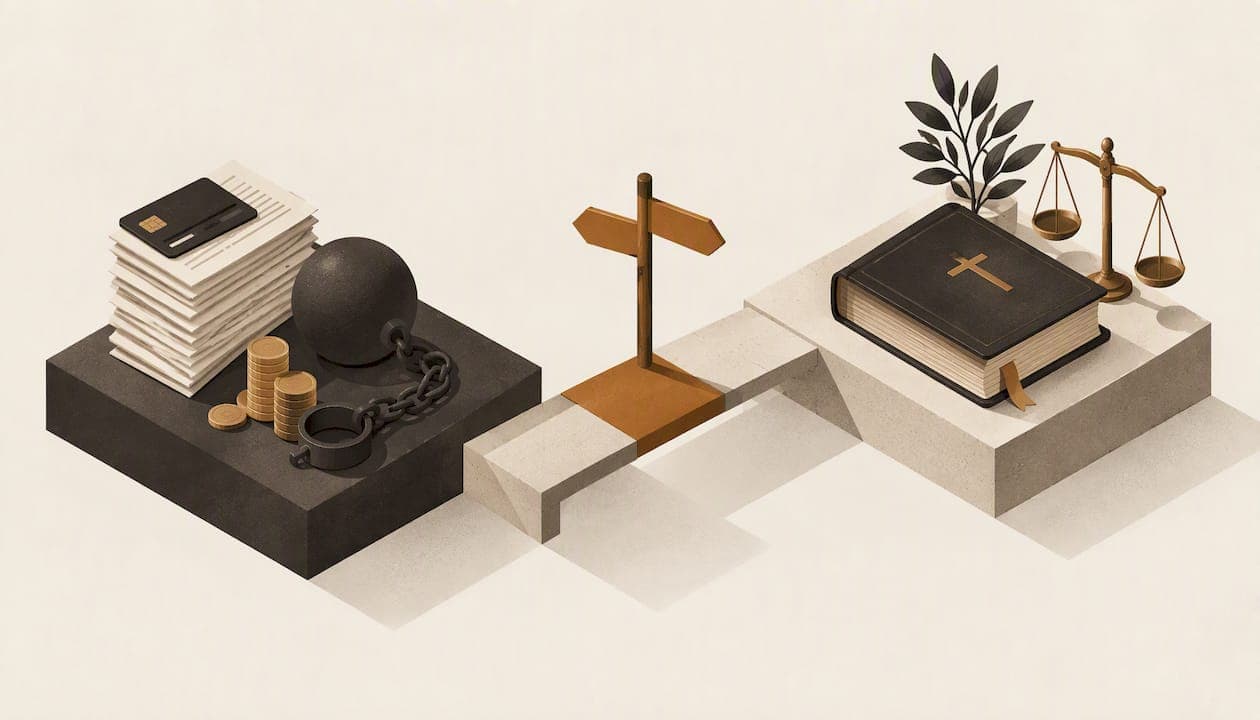
No, debt is not a sin in itself. The Bible never lists borrowing as a sin in every case, but it warns again and again about the bondage debt can bring, and it treats failing to repay as a serious matter of character. The sin question is really a heart and honesty question: why did you borrow, and are you being faithful with what you owe?
If you are carrying a balance and feeling shame about it, this is for you. You can hold a high standard and still be at peace about where you are today.
TL;DR
- Scripture does not call debt a sin, but it warns that the borrower is a servant to the lender and encourages caution.
- Refusing to repay what you can repay is what Scripture calls wicked (Psalm 37:21), not owing money as such.
- Christians hold different convictions about borrowing, and none of us should condemn one another over them.
- The practical path is a plan: a budget, a modest cushion, honest talks with creditors and with your family.
- Shame is not a strategy. A calm, prayerful conversation at home is the best first step.
Table of Contents
- The short answer: debt is not a sin, but it is serious
- What Scripture says about borrowing and lending
- Why some Christians say "avoid all debt" and others disagree
- When debt becomes a spiritual problem
- A practical plan for Christians who owe money
- Talking about debt at home without shame
- Our perspective
- Start the conversation with the Bible Money Book
- Frequently asked questions
- Sources
The short answer: debt is not a sin, but it is serious
Scholars who write on faith and economics land in the same place. One Southeastern Baptist Theological Seminary resource on faith and economics puts it plainly: the Bible does not say debt, on its own, is a sin, but it does warn against going into debt carelessly. Another perspective, from the Acton Institute, describes debt as a tool that can either improve or weaken our stewardship, which is why it should be used prudently.
That is good news if you feel condemned. It is also a challenge. Because the Bible does not give us a simple rule such as "never borrow," we are asked to use wisdom, and wisdom takes honesty about our motives, our margins and our promises.
Think of it this way. A sin is something God forbids. Debt is a financial arrangement. A sin can happen inside that arrangement: borrowing out of greed, lying to get a loan, refusing to pay when you could, or borrowing against a future you have no right to presume on. But the arrangement is not the sin.

What Scripture says about borrowing and lending
The Bible speaks about debt in many places, and the verses pull in a consistent direction. Here are the ones readers ask about most.
Proverbs 22:7: the borrower is a servant
The verse says the rich rule over the poor and the borrower is a slave to the lender, as the Association of Certified Biblical Counselors summarizes it. Notice that this is an observation, not a command. Proverbs often describes how life tends to work so that we can choose wisely. The verse tells you what debt does to your freedom: it limits your options, shapes your schedule and puts someone else's claim on your future income.
Psalm 37:21: the wicked borrow and do not repay
This is the verse that comes closest to moral judgment, and it is aimed at not repaying. According to the same seminary resource, the verse treats failure to repay legitimate debts as a moral failure and points believers toward keeping their financial promises. Borrowing is not condemned. Walking away from a promise is.
Romans 13:8: owe no one anything except love
Paul urges believers to let love be the one debt that never gets fully paid off. Many readers hear this as a ban on all borrowing. Others read it as a call to meet every obligation on time and with integrity. Either way, the heart of it is that nothing we owe should be allowed to rule us, and that we should pay what we owe.
Deuteronomy 15:6: lending is a blessing
In the promise to Israel, God says they will lend to many nations but borrow from none (Deuteronomy 15:6). Being in a position to lend, rather than borrow, is held up as a sign of blessing. It is an ideal to aim for, not a verdict on anyone who has needed to borrow.
Proverbs 21:5: plan ahead
The plans of the diligent lead to abundance. This is the quiet verse behind nearly every sound money habit: write down what comes in, decide what goes out, and do not live by impulse. For a closer look at the full list of passages, see our guide to Bible verses about debt.
Why some Christians say "avoid all debt" and others disagree
Sincere believers land in different places, and it helps to understand why.
The "avoid it" view leans on Proverbs 22:7, Romans 13:8 and Deuteronomy 15:6. Its strength is that it protects families from bondage and from presuming on tomorrow. It treats debt-free living as a goal worth striving for.
The "use it wisely" view points out that Scripture regulates lending and borrowing rather than banning them. Theology of Work distinguishes borrowing for productive purposes, such as growth, infrastructure and education, from borrowing to live above your means. A small business loan, a modest mortgage or tuition that raises a person's ability to serve others looks very different from a card balance built on dinners out.

A biblical counseling article on conflicts of conscience adds a note of grace: believers may hold different convictions about debt and should not condemn one another's decisions as inherently sinful (ACBC). If you and your spouse see it differently, that is a conversation to have with patience, not a verdict to hand down.
When debt becomes a spiritual problem
Since the sin is not in the arrangement, ask these questions of your own situation. They are heart checks, not a trap.
- Why did I borrow? Need, wise investment and emergency are different from envy, status or impatience.
- Was I honest? Did I give accurate information, and do I keep my word?
- Am I paying what I can? Psalm 37:21 speaks to a person who has the means and will not repay.
- Is this debt ruling me? If payments crowd out generosity, rest, family time or worship, the bondage of Proverbs 22:7 is real.
- Am I hiding it? Secrecy from a spouse is the clearest sign that shame has taken the place of wisdom.
If you answered honestly and found a problem, the biblical response is repentance and a plan, not despair. Repentance means turning, and turning looks like specific changes: a written budget, a stopped habit, a call to a creditor.
A practical plan for Christians who owe money
Wisdom without steps will not pay a bill. Here is a sequence families can use this week.
Step 1: Pray, then look at the numbers together
Gather statements for every balance, with the interest rate and minimum payment. Do this with your spouse. Pray first, ask for honesty, and agree that no one will be shamed in this conversation. For couples, the goal is to be on the same side of the table, facing the problem together.
Step 2: Plan your spending
Proverbs 21:5 commends planning. A simple monthly budget, with a line for giving, is enough to begin. Our walkthrough on biblical budgeting for families shows how to start tonight without a complicated system.
Step 3: Build a small cushion
A modest buffer keeps one flat tire or medical bill from becoming new debt. One commentary on Proverbs 22:7 recommends borrowing only a prudent amount and leaving margin for the unexpected, and budgeting prayerfully (Bible Hub). Margin is a way of trusting God while acting responsibly. Setting aside money for predictable costs helps too, and sinking fund categories give you a family-friendly way to do it.
Step 4: Talk to your creditors early
If you cannot meet an obligation, do not go silent. Contact the lender, explain your situation honestly and ask for a new payment arrangement. Persistence matters here, and so does contentment while you work through it. Asking for help is not a failure of faith.
Step 5: Compare your options carefully
Some families benefit from combining balances, and others from a structured repayment arrangement with a counselor. Understanding the difference between debt consolidation and debt management can help you ask better questions of any lender or counselor you talk to. Whatever you choose, read the terms, avoid anything that hides fees, and keep paying on time.
Step 6: Be cautious with high-cost loans
Very short-term, high-fee loans can turn a small gap into a long struggle. If you are weighing one, read our article on payday loans and Christians first.
Step 7: Keep giving in a way you can sustain
Many believers wonder whether to keep tithing while they owe. We address that directly in tithing while in debt, with three questions to settle as a family.
Talking about debt at home without shame
Debt hurts most where it is hidden. Silence adds weight, and children sense tension even when no one explains it.
Research supports talking about money openly. A review of a decade of studies on financial socialization found that what families teach and model is associated with later financial wellbeing, and that open family-finance discussions are linked with less financial anxiety (PMC). The same review notes that intentional parent-child money conversations are consistently associated with better financial attitudes, knowledge and behavior in adulthood.
There is a caution, too. Researchers describe "financial enmeshment" as parents sharing the burden of their financial stress with children who are not ready to process it, and it can negatively affect a child's development (ResearchGate). So the aim is not to unload every worry. It is to share information in ways that fit a child's age.
Here is how that can sound:
- Young children: "We are being careful with money right now, so we are choosing what to buy. God takes care of us, and we are working a plan."
- Tweens and teens: "We borrowed for the car, and here is how the payments work and why we are paying extra each month."
- Your spouse: "I am not blaming you, and I am not hiding anything. Can we look at this together tonight?"
A home where debt can be named without fear is a home where children learn that money is a stewardship, not a secret.
Our perspective
We have seen the same pattern over and over: families do not stall because they lack information, they stall because the topic feels heavy. The question "is debt a sin?" usually carries a second question underneath it: "am I a failure?"
Our answer is that Scripture takes debt seriously without placing you under condemnation. It asks for wisdom, honesty and faithfulness, and it offers grace to people who turn and take a step. That is why we built the Bible Money Book as a simple, plain-language guide with a practical implementation workbook, not another complicated system. It is designed to give your family one clear next step and a calmer way to talk about money, without judgment or shame.
If you take one thing from this article, let it be this: you do not need to fix everything this week. You need to start the conversation, tell the truth and choose the next faithful action. Grace meets you there.
James
Start the conversation with the Bible Money Book
If you are ready for a clear next step, the Bible Money Book is a digital guide for families and couples that puts biblical principles into simple, actionable steps for spending, debt and money communication. It is $1, and it includes a practical workbook to help guide your family discussions.

If you would like more reading as you go, browse our recommended books and resources, or put these ideas into practice with 10 biblical money principles for families.
Frequently asked questions
Is borrowing money a sin?
No. The Bible never explicitly labels borrowing a sin in every case, though it warns often about the risks (Christ and Culture, SEBTS). Sin enters when borrowing comes from greed or dishonesty, or when someone refuses to repay.
Does the Bible say Christians should be debt-free?
Scripture praises being in a position to lend rather than borrow and urges us to owe nothing but love. It does not issue a command that every loan is forbidden. Many Christians treat living debt-free as a worthy goal and work toward it step by step, while others use carefully chosen, manageable debt.
What does Psalm 37:21 say about debt?
It says the wicked borrow and do not pay back, while the righteous are generous and give. The weight falls on the failure to repay, which is why faithful repayment, or an honest effort to renegotiate, matters so much.
What should I do if I cannot pay my debts?
Start by being honest with your spouse and your creditors, write down every balance and build a simple plan. Ask lenders for a new payment arrangement and keep following up. A pastor, a biblical counselor or a nonprofit credit counselor can walk with you through the details.
Sources
- What Does the Bible Really Say About Debt? (SEBTS Christ and Culture)
- Forgive Us Our Debts (Acton Institute)
- A Conflict of Conscience (Association of Certified Biblical Counselors)
- The Right Amount of Debt (Theology of Work)
- Deuteronomy 15:6 (88.3 The Journey)
- How does Proverbs 22:7 relate to modern financial practices (Bible Hub)
- Financial Socialization: A Decade in Review (PMC)
- Financial Enmeshment: Untangling the Web (ResearchGate)
- Debt Consolidation vs. Debt Management