
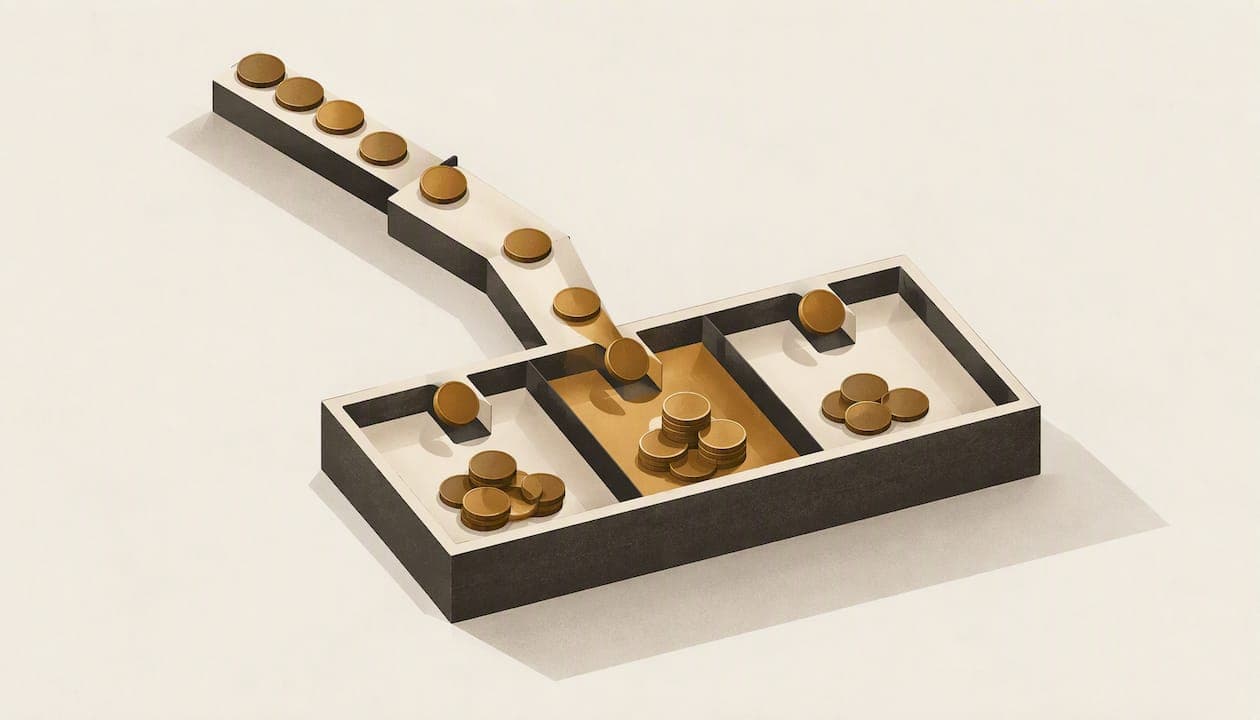
The three jar money system is a simple way to teach children about money. Every dollar they receive is split among three clear jars: one for giving, one for saving and one for spending. For Christian families, it can be more than a budgeting trick. It can become a weekly habit that shows children that money is a gift to steward, not a prize to hoard.
Below, you will find how the system works, how to set the percentages, how to give the jars a biblical shape, and how to let it grow as your child does. Our hope is that money in your home becomes a calm, hopeful conversation rather than a source of tension.
TL;DR
- Give each child three clear jars labeled Give, Save and Spend, and split every dollar of allowance, birthday money and odd-job pay among them.
- A common split is 50% spending, 40% saving and 10% giving, but for a Christian family it makes sense to put giving first.
- Research suggests that parental guidance, not the allowance alone, is what shapes adult saving habits.
- Start with rules for young children, then hand over more decisions as they become teenagers, and move on to a bank account.
Table of Contents
- How the three jar money system works
- What each jar teaches
- How to split the money: three starting points
- Give the jars a biblical shape
- Why guidance matters more than the jars
- Set it up in one evening
- Let the system grow with your child
- Common mistakes to avoid
- Our perspective
- A simple next step for your family
- FAQ
- Sources
How the three jar money system works
The idea is simple. You give your child three clear jars, each representing a different fund: spending, saving and giving. When money comes in, your child divides it among the jars with your guidance.

Why does a jar work when a bank app does not? Extension specialists at Utah State University note that talking about money and the choices made with it is a great place to start, even if you do not feel qualified. A jar makes the talk concrete. A child can see the Save jar fill, shake the Spend jar when it empties, and feel the small weight of coins set aside for someone else. Scarcity, patience and generosity stop being words and become something the hands can learn.
Clear glass or plastic matters. The point is visibility. Many parents also let children decorate the labels, which gives them ownership from day one.

What each jar teaches
The Give jar
This jar teaches that something always leaves your hands before you decide what you want. Younger children can drop coins into a church offering, buy food for a pantry drive or save for a gift for a neighbor. Older children can choose the cause themselves.
The Save jar
Saving works best when it has a name. A vague goal is hard for a child to hold, so help them pick something specific: a game, a bicycle, a birthday present for a sibling. Each time you divide the money, remind them that the more they set aside now, the sooner the goal arrives.
The Spend jar
This is the jar children love, and it is a teacher too. Let them spend it on something small and watch what happens. A toy that breaks in two days teaches more than a lecture, and the cost is a few dollars rather than a few thousand later in life. We come back to this below.
How to split the money: three starting points
There is no single correct ratio. One widely quoted split is 50% for spending, 40% for saving and 10% for giving, and you can adjust it to fit your family. Here are three ways to think about it.
| Approach | Give | Save | Spend | Best for |
|---|---|---|---|---|
| Common split | 10% | 40% | 50% | Families who want a widely used starting point |
| Giving first | 10% | 30% | 60% | Families who want to model the tithe and keep spending generous for young kids |
| Goal-driven | 10% | 60% | 30% | A child saving toward a specific big purchase |
The math is easy to teach. On a $5 chore list, a 10% gift is 50 cents. For a young child, it is often easier to hand over five $1 bills and ask them to place each one, as one parent-focused guide describes: $1 to long-term savings, $1 to charity and $3 to spending.
How much allowance is enough?
There is no official number. A 2019 survey of 1,002 U.S. adults conducted for the AICPA found children with allowances averaged $120 per month, and 80% of parents required chores. That is one data point, not a benchmark you must hit. The same guide suggests a starting point of $1 to $3 a week for young children, with clear jars for Save, Spend and Give. Choose an amount that fits your budget and your child's age and responsibilities.
Give the jars a biblical shape
This is where Christian families can go beyond the standard version. Biblical stewardship begins with the belief that everything belongs to God, as in Haggai 2:8, and it puts giving first, as with the tithe in Leviticus 27:30 and the cheerful giver in 2 Corinthians 9:7. Both ideas appear in a conversation with Dr. Shane Enete on Jesus-centered money habits for families.
So consider renaming the jars:
- Give becomes Tithe and Offering. One resource for churches suggests the jars can represent the tithe (10%), offerings and savings, which teaches children that giving is the first tenth and that they are stewards of what is God's.
- Save becomes Plan. It covers goals, future needs and the idea of not spending everything today.
- Spend becomes Enjoy. Money used well and gratefully is not a sin. Gratitude, not greed, is the goal.
A small ritual helps. When you divide the money each week, pause for one sentence of thanks. Children remember that more than any percentage.
Tell the story, not just the rule
Dr. Enete argues that stories are the most effective way to teach stewardship. Rather than a lecture on percentages, he suggests sharing Bible accounts about money and inviting children to respond. Pick one story a month, read it at the table, and ask one question: what did that person do with what they had?
If you want verses to build on, our post on 12 Bible verses about money for Christian families gives you one tiny action for each. For a longer series, try our Bible study on money for families.
Why guidance matters more than the jars
The jars are a tool. You are the teacher. A long-term analysis of Dutch data found that parental teaching to save increases the likelihood that an adult will save by 16% and the amount saved by about 30%. The study also found that the best approach combined several methods: giving pocket money, controlling how it is used, and giving advice about saving and budgeting. In other words, the allowance by itself is not enough. The conversation is what matters.
That should be encouraging. Utah State's extension team says you do not need to be an expert. You need to be present, talk about your own money choices (including the mistakes) and keep the conversation going.
One caution from our side: children notice hypocrisy. A project report from the University of Toronto on a money jars app for children aged 6 to 10 describes the point that children are quick to spot a lack of parental integrity. If you ask your child to give first and then complain about every offering, the jars will not carry the lesson. Let them see you give, gladly.
Set it up in one evening
- Pick the jars. Three clear jars or containers per child. Label them together.
- Choose the split. Decide with your spouse first, then explain it to the kids in one calm sentence.
- Define what counts as income. Allowance, birthday money and odd jobs all go through the jars, as many families do. Decide about small gifts in advance.
- Pick a payday. The same day every week, so the habit becomes automatic.
- Name one goal. Write it on the Save jar with the price.
- Plan the first gift. Let your child choose where the Give jar goes this month.
- Review monthly. Open the jars together, count, celebrate and adjust.
If you are still working out how chores and allowance fit together, read our post on chores and allowance from a biblical perspective.
For families who want more hands-on money practice around the house, a 30-day workbook on resetting spending habits can pair well with the jars. It offers printable trackers and scripts for money conversations, which are useful when kids see you changing your own habits.
Let the system grow with your child
Three jars are right for ages 6 and up and for early elementary children. They are not meant to last forever. The research summary we reviewed describes the best systems as simple enough for young children yet flexible enough to evolve, eventually moving to bank accounts and conversations about investing.
Rules for young children, trust for teenagers
Young children need guardrails, so you set the percentages. Teenagers need room. Swiss research on pocket money observes that the key is a gradual shift: autonomy grows with age, and children learn from both success and mistakes. That study looked at Switzerland, where pocket money ranges from five francs for young children to 150 francs for teenagers, so treat the amounts as a local picture, not a U.S. rule.
Here is a simple path:
- Ages 5 to 8: Parent sets the split. Cash in clear jars.
- Ages 9 to 12: Child proposes the split and defends it. Saving goals get longer.
- Ages 13 and up: Move most of the Save jar into a bank account, and let the teen manage a larger share of their own spending, including clothes or a phone plan.
Mistakes are part of the plan. When your 10-year-old spends everything in a day and regrets it, resist the rescue. A coaching question, such as "What would you do next time?", does more than a lecture.
When your family starts talking about bigger things, such as a family budget or saving for periodic costs, our posts on biblical budgeting for families and sinking fund categories are natural next steps.
Common mistakes to avoid
- Making the system too rigid. Structure helps, but children learn best when they can make some allocation decisions themselves, even imperfect ones.
- Turning giving into a tax. A child who gives under pressure learns resentment. Talk about why, tell the story, and let them pick the recipient.
- Skipping the conversation. The jars without the talk lose most of their power.
- Raiding the Save jar. If you borrow from it, repay it and say so out loud.
- Comparing siblings. Different ages and personalities need different amounts and goals.
Our perspective
We built our work around one belief: families do not need a complicated system to talk about money well. They need a clear next step and a tone with no shame in it. The three jar system fits that belief because it is physical, cheap and honest. A child can understand it in one sitting.
What we have seen again and again is that the jars are the easy part. The harder part is the parents' conversation: who handles money, what we are afraid of, how we give. Children pick up the answers whether we speak them or not. So we encourage you to start with your own heart. Ask what your jars would look like if you were a child watching you. Then adjust, gently, and without guilt.
And if you worry that you have already made mistakes with money, take heart. The goal is not a perfect record. It is a household where money is a tool God has put in our hands, to be used with gratitude, wisdom and open hands.
— James
A simple next step for your family
If you want help turning these ideas into calmer family money talks, the Bible Money Book is a digital guide with simple, actionable steps rooted in biblical principles, plus an implementation guide for family discussions. It costs $1. You can also browse our recommended Christian books, Bibles and gifts for devotionals and coloring books to share with your kids.
FAQ
What is the three jar method?
It is a way to teach children to divide any money they receive into three jars: Save, Spend and Give (sometimes called Share). Children see their money grow in each jar, which makes budgeting concrete. Parents guide the split at first, then step back as the child matures.
What percentages should my child use?
There is no required split. A common one is 50% spending, 40% saving and 10% giving. Christian families often keep the 10% for giving as a picture of the tithe and adjust the other two to their child's goals.
At what age can a child start?
Many programs aim at elementary-aged children, around ages 6 to 10, but the idea can be adapted for younger kids with pretend money and a simple $1 to $3 weekly allowance. Keep the system simple at first. You can add rules as your child understands more.
Should I tie allowance to chores?
Families differ on this. In the AICPA-commissioned survey mentioned above, 80% of parents required chores for allowance. Some families prefer to treat allowance as teaching money and chores as part of belonging to the household. Our article on chores and allowance walks through the biblical thinking on both.
When should we move beyond jars to a bank account?
When your child is consistently handling the jars and starts saving amounts too large or too long-term for a jar, usually in the preteen or early teen years. Move the Save portion first, then discuss how a bank account works, and keep Give and Spend as cash for a while longer.
Sources
- Budgeting for kids: The 3-jar money system (Fulton Bank)
- How to Teach Kids About Money: Tips and Examples By Age (SmartAsset)
- Teaching Children to Save (Netspar)
- Teaching Children Money Management (Utah State University Extension)
- Jesus-Centered Money Habits for Families with Dr. Shane Enete (Summit Ministries)
- Dollars and Sense from Grandmother (Adventist Stewardship)
- Should Kids Get an Allowance? (ChoreSplit)
- Money Jars final report (University of Toronto)
- Children, money and the path to independence (PostFinance and Sotomo)